Review: The Priory of the Orange Tree

29774026.jpg

5 stars. WELL THAT WAS A VERY TALL MOUNTAIN. I climbed The Priory of the Orange Tree and survived! Apologies to all the other books rotting away on my Kindle, had to take a little break from my two-books-a-week pace to tackle this. No regrets.

First things first - I enjoyed but did not love The Bone Season, and REALLY disliked its sequel, so I went into this with low expectations. Samantha Shannon seems like a talented, intelligent, delightful person, but I've reacted negatively to her writing style in the past (more on that later). I'm happy to say that her ability has grown and I give this, with no hesitation, a full five stars.

The book is long and there are a lot of characters, but the premise itself is fairly simple: a group of kingdoms (countries?) must prepare for the destructive awakening of an evil dragon. Rules must be cast aside, myths must be dusted off, and enemies must join together (etc. etc.) to ward off this threat and maintain the state of the world.

It sounds kind of cliche, maybe even a little too casual, but I promise it's very engaging. We have dragons, sorcery, secret societies, alchemy, pirates, monsters, and more. It's a good example of complex but accessible worldbuilding - accessibility being my #1 criteria for fantasy. I could actually remember where we left off with characters from three chapters ago, I didn't encounter impossible vocabulary terms, and I didn't have trouble grasping the intricate cultural details. So many authors try to show off their worlds, and Shannon isn't one of them. Mostly.

In fact, I can see this appealing to a huge audience - even those who aren't drawn to fantasy. The feminism is bright neon, and the central love story is queer as queer can be. It's a satisfying girl power book. The characters are easy to root for and the action sequences are really compelling. It isn't juvenile, in my opinion, as some have implied, although it doesn't get very nasty (I would've loved chapters from the POV of a [true] villain). It's similar to a TV show in which characters experience long arcs and slowly congregate towards each other, spiraling around the central threat.

Okay, now that I write this, maybe it is a little juvenile. There are a lot of blatant “lessons” about acceptance, tolerance and friendship (although these days it’s sadly necessary to hit people over the head with stuff). And at times I felt it was maybe even a little TOO simple. Shannon created an old and complex map here, complete with mythology and lore and traditions and religions and everything in-between, but it felt like the window was small, like everything important operated among a small circle of folks. Like I was reading about a place the size of Ohio, instead of the size of the world.

And it's a slow burn, for sure. It's enormous. The prose teeters on the edge of purple for me - something that was really irritating in The Mime Order (if she "crowned her bread with butter" one more time...) but appeared toned down in this book. Still, the descriptions of the food, plus sentences like "Its paths were honeyed by the sun, and the roses that trimmed its lawns held a soft blush" and "Dawn cracked like a heron's egg over Seiiki. Pale light prowled into the room" were jarring for me, and eye-rolly. The sex scenes were flowery to a fault. That might be a personal preference, though.

ALL THAT being said, I can’t give this anything but five stars. I'm probably just nitpicking because I spent SO MUCH TIME with this thing. It's clear that so. much. thought. and care and deliberation went into this book - it's an incredible accomplishment and deserves all the praise. It's a very long, very detailed collection of fairy tales, woven together in a beautiful tapestry. It's an epic adventure that WILL find it's place on the classics shelf. I can't wait to see the inevitable adaptation.

The Priory of the Orange Tree on: Amazon | Goodreads

Retro Review: The Goblin Emperor

When I started this blog, I had been posting reviews on Goodreads for about 6 months. In the interest of having all of my book writing in one place, I will post one of these old reviews every Friday. They weren't written with a blog in mind, so please forgive the lack of summary and off-the-cuff tone.

17910048.jpg

5 stars. In this quietly epic political fantasy, an unprepared half-goblin named Maia inherits the throne as the rightful heir to his father's kingdom. Thrown into a world of political intrigue, Maia struggles to evaluate his court, thwart assassination attempts, and learn who to trust.

So, I really liked this. I liked the writing, the characters, the setting (as envisioned by my imagination, I guess), and the plot. It was refreshing to read from the perspective of a personality that is complex but reliable. By reliable, I mean reliably good. Is Maia perfect? Absolutely not. Does he make mistakes? Frequently. But ultimately, he is a strong, admirable hero who listens to his instincts and does not succumb to temptation or corruption. So many times I open a book and cringe at the actions of the protagonist - which isn't a bad thing, because that technique keeps things interesting and is there anything better than an antihero? - but this book provided the break from epic fantasy darkness that I didn't know I needed.

I truly admire successful world-building, as indicated in my reading interests and habits. Sometimes I get frustrated, though, when authors get too caught up in the building - and essentially neglect the storytelling. Yes, it's impressive that you constructed a society, developed a language, and thought through so many details. You know what's even more impressive? Effectively including those details in a narrative. This book just barely achieved that balance (just barely), and while at times the language and naming system was confusing, the point of the story came across strong.

It didn't rip me apart from the inside. I wasn't beside myself with anxiety for the characters. I wasn't totally moved. But I was absolutely captivated. This little story is CREATIVE, gripping, fun, well-written, and includes tremendously important themes to consider in today's age of social unrest. There's something for everyone and I highly recommend.

The Goblin Emperor on: Amazon | Goodreads

Retro Review: The Golem and the Jinni

When I started this blog, I had been posting reviews on Goodreads for about 6 months. In the interest of having all of my book writing in one place, I will post one of these old reviews every Friday. They weren't written with a blog in mind, so please forgive the lack of summary and off-the-cuff tone.

15819028.jpg

4 stars. I would go so far as to say that certain aspects of the golem and the jinni's experiences are very relatable. We have all felt like outsiders. We have all felt frustrated with our natural inclinations or limited by our tendencies. We have all felt restless or stuck by societal constraints. We have all, at some point, lived in fear of judgment by others. Why is it so challenging, then, to apply this mutual understanding - this compassion - to people who don't look like us? Who don't talk like us? Who don't share our religious beliefs?

It's a complicated and disheartening question that's easy to pull from this seemingly quiet narrative. Helene Wecker uses the perspective of an outsider - not only a cultural outsider, but a physical one - to whisper insights about our differences and our similarities and especially our rush to judge.

Yes, the message is critical in that sense. But I was struck by the depiction of goodness in this book; the resilience of human nature and the strength of human kindness. For some reason, we are prone to reject those who are different. But some of the characters in this story demonstrate a deep consideration for others despite (because of?) their differences.

Logistically - this book ran a little long for me. It drags in the middle, as many others have pointed out here. It perhaps could have benefited from some narrative editing. But the writing is so simple and elegant it almost feels suited for a slower, luxurious pace. The author develops her characters with tender loving care and dedicates space to illustrate their thoughtful layers.

Along those lines, the author, in my opinion, successfully demonstrates female complexity - especially when it comes to sexuality. We have several characters here that serve as willing, enthusiastic participants in sexual activity. No bewitched, confused victims here. There's ignorance maybe, or a disregard for consequences, but these women experience sexual pleasure and in some cases even initiate it. More of that, please.

I am neither Jewish nor Arabic, so forgive my error if I observe incorrectly here: the author seems to depict these cultures lovingly, carefully, and (unlike her obvious encouragement of tolerance and open-mindedness) without agenda. The customs and beliefs and traditions portrayed aren't labeled as right or wrong - they are simply vehicles for comfort, familiarity and perhaps true magic. I don't know if it is pro-religion, per say, but it certainly isn't anti. It's just part of the story.

I felt this book as a woman, and as an American.

The Golem and the Jinni on: Amazon | Goodreads

Review: Alice's Adventures in Wonderland

2019 CHALLENGE: 1 RE-READ PER MONTH 02 / 12

24213.jpg

4 stars. THIS BOOK IS SO STRANGE! I fucking loved it as a kid but wow - this book is a really, really bizarre acid trip. In a good way.

I know so much has been said about Lewis Carroll and the possible inspiration for Alice's Adventures in Wonderland. I can't personally add anything about that, except that I hope it's not true and I hope this classic remains untarnished. Because it's truly a one-of-a-kind, unprecedented and kind of unmatched as far as children's literature goes.

(Also, there’s no evidence that Lewis Carroll did drugs. Just sayin’.)

Now that I'm older and more well-read, this reminded me of a lot of my favorite authors growing up: Roald Dahl, Clive Barker (the Abarat series features an interested sort of Wonderland), CS Lewis, Norton Juster, etc. This really felt like kind of a warm up for books like that, or like it sprouted branches and now we can enjoy it’s fruit. It's charm and wit will probably keep inspiring authors as long as books exist. I also personally love books like Alice (Christina Henry) and other dark renditions. 

But the one thing that really stuck out during my re-read was how much I absolutely love Alice. What a badass, world-hopping, roll-with-it warrior!  

"The table was a large one, but the three were all crowded together at one corner of it: 'No room! No room!' they cried out when they saw Alice coming. 'There's plenty of room!' said Alice indignantly, and she sat down in a large arm-chair at one end of the table."

I love her.

“One of the jurors had a pencil that squeaked. This of course, Alice could not stand, and she went round the court and got behind him, and very soon found an opportunity of taking it away."

She's fantastic. Alice couldn’t stand the squeaky pencil, so she took it away.

"Hold your tongue!' said the Queen, turning purple. 'I won't!' said Alice." 

I don't understand why Alice isn't more regularly recognized and featured as a young feminist heroine. She's so cool and clever and, of course, curious. 

I was also really into the way Lewis Carroll handled the lack of explanation for events. I'm always intrigued by books that don't give you a chance to question things. I know that some people prefer answers to EVERYTHING, they hate ambiguity. I see the beauty in it. I suspect Carroll was aware that children wouldn't mind, even poking at the concept a bit:

"'What IS the use of repeating all that stuff,' the Mock Turtle interrupted, 'if you don't explain it as you go on? It's by far the most confusing thing I ever heard!'"

Not as confusing as it may seem, ha. It definitely comes across as a book that's "just for fun," but I wouldn't be surprised if there was playful meaning behind every joke, every twist of dialogue, every story and riddle and interjection. That's what makes it so rewarding for children and adults - the magic and the meaning. It's not for everyone, but it's hilarious and weird and an amazing piece of writing and completely worth your time.

Alice’s Adventures in Wonderland on: Amazon | Goodreads

Review: The Witches of New York

20053031.jpg

4 stars. In this charming and fiercely feminist story, three witches unite in 1880 New York: seventeen-year-old Beatrice (a talented young lady looking for magic and a new life in the big city), Eleanor St. Clair (a thirty-something owner of a useful shop called Tea and Sympathy - would like to go there, thanks!), and Adelaide Thom (a courageous young woman living with scars both visible and unseen). All three find companionship, support and magic by leaning on one another to fight traditional expectations, societal constraints and supernatural threats. There’s a surly talking raven, a Civil War vet, a Bird Lady, a Giant Obelisk, a villainous preacher and a couple of colorful ghosts ("Just as a child learns reading, writing, and arithmetic, the dead had to tackle their three Rs as well: revenge, regret, and reconciliation.") plus demons. It’s quite a crowd.

McKay's tone is matter-of-fact and humorous, but there's an undercurrent of anger, causing The Witches of New York to feel light and heavy at the same time. It tries to be fun and deep. The danger never seems real and we completely expect a happy ending, but it tackles such important, weighty subjects: the strength, courage and fortitude of women, the power of friendship, the complicated and wonderfully imperfect nature of being female, the struggle of being female, the struggle to push against the patriarchy when it pushes back twice as hard. It's lovely, really, and sends an important message.

It's not flawless. There are a lot of characters here - fleshed out characters with agency, to McKay's credit - but it almost feels Dickension (not in a good way). It was a little hard for me to keep track of; a little too expansive for its own good. Perhaps McKay was trying to emulate Jonathan Norrell and Mr. Strange? A lot of it just seemed unnecessary. I love stories with layers, but this one had too many. I also question the romantic subplot(s) - ladies, you don’t need a man/significant other to live fulfilling lives!

And there's a very, very, very apparent lack of diversity. This is about female empowerment - as it turns out, white female empowerment. I would've been very interested and very happy to read any included diverse voices, and I think, considering the time and place of this book's setting, they would've added a lot. Overlooking these voices is counter to the aforementioned message. 

Despite these weaknesses, The Witches of New York is strong. It made me smile. It's very well-researched and the details are absolutely charming, which reminded me somewhat of The Alienist (only the tidbits about New York! That book is not for the faint of heart!). I really rooted for our heroines and appreciated such an intense (if not well-rounded) exploration of female identity. I’ve never read Practical Magic, but I’ve seen the movie, and can guess that it has similar vibes. I found myself wanting to bookmark the tea recipes and try the little magic tricks for warding off evil. Ami McKay is an excellent and sophisticated writer and it shows. I wanted something soothing and quiet, and this delivered, with a lot of meaning tucked in its pages. 

The Witches of New York on: Amazon | Goodreads

Review: The Traitor Baru Cormorant

23444482.jpg

3 stars. My second DNF on Goodreads! It's in my nature to be stubborn and stick with things, but about halfway through this I took a step back and realized I was done. The Traitor Baru Cormorant is not a bad book at all, I'm just the wrong reader for it. Nothing against Seth Dickinson and his frankly impressive worldbuilding here, but I wasn't interested.

Super high level summary: a fierce and intelligent young woman infiltrates the group that conquered her homeland intending to stoke the flames of rebellion from within their highest ranks. It's painful, for her: navigating the system, learning who to trust, weaving together the millions of threads required to reach her goal. We get front row seats as she experiences the growth and great personal sacrifice required to change the world. It's a fantastic premise.

And I want to recognize that this book deals with some incredibly important themes - homophobia, racism, gender dynamics, colonialism, power - in incredibly insightful ways. I really admire authors who successfully tackle stuff like that in complex fantasies, because it can go so wrong. So many pitfalls to avoid! Dickinson pulls through, at least in the first half of the book, with a nice balance of cleverness and sensitivity.

So why did I put it down? Well, I hate math. I love that Dickinson tried to demonstrate the power of money here (I love considering the concept of conquest from all angles), but I have to admit that most of it was pretty over my head. I also couldn't hold onto certain delicacies within the plot, nor could I easily remember or recognize most of the characters. I'm a really careful reader, but I just couldn't stick with the writing style here. It felt sloppy, to me. It's totally, totally fine for an author to rely on his or her readers to draw conclusions, make jumps, recall plot points, etc., but this felt extreme. (And I almost say that sheepishly, less as a criticism and more of an admission that maybe I'm not smart enough?)

But it's certainly unique, and I may be tempted to pick it up again. Baru is an awesome character. The way she struggles with her sexuality feels so potent and tragic and hopeless. In that sense, it's really powerful writing. And I appreciate that Dickinson isn't preachy or sanctimonious, he just lets the chips fall. I can't really recommend this, and I can't comment on how it ends, but I fully acknowledge that there's something interesting here. It just isn't for me.

The Traitor Baru Cormorant on: Amazon | Goodreads

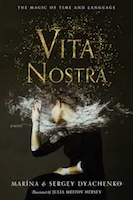
Review: Vita Nostra

38633526.jpg

4 stars. WOAH. I am dizzy. This book is everything I expected - bizarre, abstract, insane. It’s also beautiful, darkly beautiful - defiant, philosophical fantasy at its finest. I took my time with this, and I’m glad I did, because it requires patience, discipline - a studious eye - to complete. There are elements of many genres here - coming-of-age, fantasy, science fiction, horror, magical realism. It’s best to approach it without expectations, without the intent to put a label on it.

Yes, yes, I know, first things first: Vita Nostra has definite Harry Potter vibes, as many have said. A vacationing teenage girl is approached by a mysterious stranger who requests - compels - her to complete strange, potentially dangerous tasks in exchange for gold coins. These coins are eventually used as payment for admission to the Institute for Special Technologies, a weird and scary school in an isolated village. The girl, Sasha, discovers that she has a gift for the work she is assigned, sparking a transformation that she does not understand; one she cannot control or stop.

Let me be upfront: you, as a reader, will not receive all the answers. The authors successfully paint a breathtaking and compelling picture here, but you will never see the full image. Blindly exploring the themes and ideas was enough for me and in fact a refreshing exercise, but it will not be satisfying for others. Had I not been in the right mood, reading this would’ve felt frustrating and wasteful. Beware, interested readers, you will be forced to navigate uncomfortable waters here.

But yes, I loved it. I truly enjoyed stumbling around bumping into concepts such as consequence, fear, love, discipline, obligation, transformation, and destiny. This book is dark - and simmers with foreboding - but there is something so charming about Sasha; I really fell in love with her shenanigans as a gifted student and an awkward teenage girl. I appreciated getting to know her allies, her supporters, her family, her professors. I really rooted for her, without knowing where she was headed, or how she’d succeed. It’s quite something.

At the risk of beating a dead horse, this is not for the faint of heart. But I’d recommend it for anyone interested in taking a deep, dark dive into abstract philosophy.

Or perhaps anyone interested in what it feels like to take LSD. Russian LSD.

Vita Nostra on: Amazon | Goodreads

Retro Review: The Leftovers

When I started this blog, I had been posting reviews on Goodreads for about 6 months. In the interest of having all of my book writing in one place, I will post one of these old reviews every Friday. They weren't written with a blog in mind, so please forgive the lack of summary and off-the-cuff tone.

10762469.jpg

4 stars. I'm glad that I knew to expect a quiet book before I picked this up. I'm a huge fan of the television show - one of the gutsiest ever written - and had high expectations, for sure, but I knew going in that I likely wouldn't feel ... satisfied. Well, I guess I was satisfied, but not in a comparable way.

The plot is similar: following what appears to be some sort of rapture-like event, several residents of Mapleton, New Jersey attempt to navigate a traumatized world and learn to live without answers.

I think one of the most important things I ever learned, or accepted, is that there is no right or wrong way to grieve. Recovery is not black and white, and everyone reacts to trauma differently. You should not expect a grieving individual to react the same way you would - nor should you expect them to feel comfort from things that offer you comfort. One size simply does not fit all.

This is my preferred way to interpret this book. It's my favorite thing to draw from the story. Simply written, and almost painfully human, The Leftovers examines connected individuals of all ages, shapes and sizes, and how they react to the incredibly traumatic Departure. This book tells their stories without reluctance and without judgement - detailing messy pain and exploring how human connection helps and hurts, sometimes simultaneously.

It doesn't always feel good. It's hard to see people struggle, to witness them spiral into depression, or denial, or anger, or fanaticism. But it happens, and The Leftovers depicts this quietly, subtly. Maybe it's a warning, maybe it's a statement of the inevitable. Maybe it's a combination of both - humans are fragile and also resilient. Some things get back to normal, some things are ruined forever. Again, my favorite lesson: one size does not fit all when it comes to recovery.

The book’s version of The Leftovers is a different, less wacky interpretation of an idea. A little footnote to the grand themes illustrated by the show. It's fascinating but maybe a little less compelling. I really enjoyed it, though.

The Leftovers on: Amazon | Goodreads

Retro Review: The Eyre Affair (Thursday Next #1)

When I started this blog, I had been posting reviews on Goodreads for about 6 months. In the interest of having all of my book writing in one place, I will post one of these old reviews every Friday. They weren't written with a blog in mind, so please forgive the lack of summary and off-the-cuff tone.

27003.jpg

4 stars. What a delightful, quirky book.

I'm not even sure where to begin, actually.

First of all, as an English Literature graduate, I got such a kick out of the premise. Not just the premise, really, but the world-building. What a fantastic opportunity to escape into a world in which literature shapes society, in which books are considered priceless cultural heirlooms, in which cults are formed based on theories of authorship and the government dedicates an entire faction to "literary crimes." The Eyre Affair grants my wish to experience a world in which everyone - everyone - is as obsessed with reading as I am. The literary inside jokes are astoundingly funny.

It's also wonderfully British. I could practically hear the accents in the perfectly paced conversations. The English setting lends to the lightheartedness of the story and the charm of the characters. It's mocking but in a loving way and made me homesick for London. I really, really appreciated the author's obvious love for Jane Eyre, and Shakespeare, and Dickens - it's clear that this book (or these books, I haven't read any others in the Thursday Next series), are his love letters to the classics.

It's also a bit difficult to swallow, at first. Perhaps because of my degree, it takes more effort for me to suspend belief without the burden of analysis - somewhere along the way, I've forgotten how to simply sit back, employ full acceptance of what I'm reading, and relax and enjoy the ride. This is a perfect reminder that unique storytelling comes in all weird shapes and bizarre sizes, and even occasionally-cutesy "fluff" can have something meaningful embedded in its pages.

This is not a book to be taken seriously, but it is seriously enjoyable and great. I'm into Thursday Next and will be reading more.

The Eyre Affair on: Amazon | Goodreads

Review: The Witch of Willow Hall

37007910.jpg

3 stars. I picked this up determined to prolong the spookiness in my life after Halloween (and after finishing The Chilling Adventures of Sabrina). I was hoping for something dark, scary, and witchy - and ended up with what was essentially a less sophisticated Jane Austen romance novel. No, I didn’t hate this, hence the middle-ground rating, but it wasn’t what I wanted.

The Witch of Willow Hall tells the story of Lydia Montrose as she attempts to adjust to a new home after her family is exiled from Boston. It is the early 1800s and the Salem witch trials are a not-so-distant memory. Lydia struggles to keep the peace with her two sisters, to sort out her feelings for a handsome neighbor, and to deal with an unseen threat that seems to emanate from Willow Hall - and from within herself.

The premise is interesting enough, but I just could not get behind our heroine. I’m so peeved by characters who are idiotic about their own feelings - it’s called attraction, dummy! You aren’t blushing “for some reason,” you aren’t weak at the knees “inexplicably,” it’s because you’re in lust with somebody! I don’t care what time period you’re from, that shit is universal.

Lydia also - quite unfortunately - confuses, or negates, the feminist undertones of the story. There are some great moments - moments where she demonstrates true female empowerment, and female complexity. And the next moment, she’s fainting into her true love’s arms for really no reason at all. I just don’t get that. She’s a fantastic sister, a forgiving daughter and a badass witch. But this treads dangerously into “not without a man” territory.

Speaking of the romance, I’m sorry, but it didn’t feel real for me. I spoke about one trope already, but there are many here. Insta-lust, sexual tension, a weird love triangle (square?) and some random incest? Hester Fox is actually a BEAUTIFUL linguist, and I loved her way with words, but there’s a lot of room to grow in her plotting.

I’m so sorry, but this wasn’t truly gothic for me. It was somewhat atmospheric, but it wasn’t haunting. It gets three stars because it is a page turner, and because I appreciate the intent here. I’ll likely read more by this author and support her efforts. We always need more stories about strong women! This just wasn’t nasty enough for my tastes.

The Witch of Willow Hall on: Amazon | Goodreads