
Review: Shirley Jackson: A Rather Haunted Life
/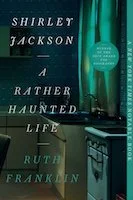
10 stars. I highly, highly recommend this compelling and detailed biography. For those curious about Shirley Jackson's life, this book offers two golden outcomes: it will satisfy your curiosity and elevate your reading experience of her works. It's the perfect blend of gossipy and academic; it's possibly the most successful, engrossing biography I've ever read and will make the Kelly Choice Awards, no question.
Organized chronologically, A Rather Haunted Life begins with Jackson's family background early upbringing, eventually settling into a rhythm where each chapter dives into a major work - notes on its development, a summary, some excellent analysis, and the public reaction - with the life stuff woven in. The author, Ruth Franklin, incorporates well-placed pictures, footnotes, excerpts, and quotes, painting what rings to me as a fair and accurate portrait of one of the most brilliant American minds.
There are major themes: Jackson's fraught relationship with her mother, for example, her messy marriage, and the impossible push and pull Jackson felt between her occupation and her role as housewife and mother herself. These are prominent themes in the biography and also themes in Jackson's work. But Franklin never neglects the little details - the minor tidbits - that make Jackson so effective and admirable:
"In “Notes for a Young Writer,” a lecture on writing fiction composed as advice to her daughter Sarah, Jackson would relish the “grotesque effect” of the “absolutely wrong word”: “ ‘I will always love you,’ he giggled.”"
I should admit that I am the perfect audience for this sort of thing: a wannabe student of the horror genre and a Shirley Jackson superfan. Every page was interesting to me. I didn't want it to end. I read and re-read passages, returned and referenced many times (the chapter on her encounter with Dylan Thomas was especially fascinating, as were the descriptions of Bennington College, one of the most unique higher institutions in America).
Some readers may feel that Franklin expects a bit too much. My own gaps in knowledge around Marxism and Communism and the American political landscape pre-WWII were super apparent. And I'm embarrassed to say that I didn't recognize many of the author names - popular contemporaries of Jackson and Hyman. That's okay - more to learn. It didn't impact my understanding or takeaways about the book's subject.
Speaking of takeaways, a big personal one for me involves parallels. Franklin points out the way McCarthyism echoes the Salem Witch Trials, a topic on which Shirley Jackson published a book. Jackson notes these familiarities between past and present below - and it's impossible to not continue the pattern and draw lines connecting the past, Shirley's present, and our present today.
"But if “fashions in fear change,” people do not. The intelligent are in the minority, their measured voices in constant danger of being drowned out by the din of the mob. “We are not more tolerant or more valiant than the people of Salem, and we are just as willing to do battle with an imaginary enemy,” she wrote resignedly. “The people of Salem hanged and tortured their neighbors from a deep conviction that they were right to do so. Some of our own deepest convictions may be as false. We might say that we have far more to be afraid of today than the people of Salem ever dreamed of, but that would not really be true. We have exactly the same thing to be afraid of—the demon in men’s minds which prompts hatred and anger and fear, an irrational demon which shows a different face to every generation, but never gives up in his fight to win over the world.”"
I'm so used to hearing the word "unprecedented," I forgot that political bullshit has existed since the beginning. To be reminded so eloquently is somehow both distressing and comforting at the same time.
The idea that so much is apparently and unfortunately universal across time and space manifests in other, more personal ways. I was really struck by the sense of kinship I felt with someone who lived decades ago, in a different world. The struggles a young Shirley experienced in adolescence and early adulthood were familiar - classic tropes, really: feeling like an odd or ugly outsider, feeling unwanted, feeling socially/romantically undesirable and awkward/ungainly. That familiarity stayed with me through her anxieties of raising children in a chaotic world. The undeniable pull Shirley felt to leave - to drop everything, to untether herself, to just exist, almost noncorporeal, even at the cost of so much - is understandable, and relatable.
One more thing: many words are included on the various questions and interpretations around the meaning of The Lottery - which was a true cultural moment. But honestly (and this in my mind is reinforced by her grumbling about it), it seems to me that Jackson simply baked a dough made of her astute perceptive nature, her dark humor, her penchant towards sarcasm and exaggeration and irony, plus her knowledge of ritual, and out came the story. I’d believe that sooner than I’d believe in some sort of preachy social commentary or agenda, though some of that was probably baked in naturally.
A Rather Haunted Life is so many things: a portrait of a person, and a marriage; a literary analysis; a snapshot of a specific moment in American history; a glimpse into the world of the generation that raised my parents; a study of repressed rage. And now it's also my entire personality.
Shirley Jackson: A Rather Haunted Life on: Amazon | Bookshop.org | Goodreads | StoryGraph