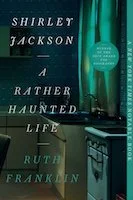
Review: Shirley Jackson: A Rather Haunted Life

10 stars. I highly, highly recommend this compelling and detailed biography. For those curious about Shirley Jackson's life, this book offers two golden outcomes: it will satisfy your curiosity and elevate your reading experience of her works. It's the perfect blend of gossipy and academic; it's possibly the most successful, engrossing biography I've ever read and will make the Kelly Choice Awards, no question.

Organized chronologically, A Rather Haunted Life begins with Jackson's family background early upbringing, eventually settling into a rhythm where each chapter dives into a major work - notes on its development, a summary, some excellent analysis, and the public reaction - with the life stuff woven in. The author, Ruth Franklin, incorporates well-placed pictures, footnotes, excerpts, and quotes, painting what rings to me as a fair and accurate portrait of one of the most brilliant American minds.

There are major themes: Jackson's fraught relationship with her mother, for example, her messy marriage, and the impossible push and pull Jackson felt between her occupation and her role as housewife and mother herself. These are prominent themes in the biography and also themes in Jackson's work. But Franklin never neglects the little details - the minor tidbits - that make Jackson so effective and admirable:

"In “Notes for a Young Writer,” a lecture on writing fiction composed as advice to her daughter Sarah, Jackson would relish the “grotesque effect” of the “absolutely wrong word”: “ ‘I will always love you,’ he giggled.”"

I should admit that I am the perfect audience for this sort of thing: a wannabe student of the horror genre and a Shirley Jackson superfan. Every page was interesting to me. I didn't want it to end. I read and re-read passages, returned and referenced many times (the chapter on her encounter with Dylan Thomas was especially fascinating, as were the descriptions of Bennington College, one of the most unique higher institutions in America). 

Some readers may feel that Franklin expects a bit too much. My own gaps in knowledge around Marxism and Communism and the American political landscape pre-WWII were super apparent. And I'm embarrassed to say that I didn't recognize many of the author names - popular contemporaries of Jackson and Hyman. That's okay - more to learn. It didn't impact my understanding or takeaways about the book's subject.

Speaking of takeaways, a big personal one for me involves parallels. Franklin points out the way McCarthyism echoes the Salem Witch Trials, a topic on which Shirley Jackson published a book. Jackson notes these familiarities between past and present below - and it's impossible to not continue the pattern and draw lines connecting the past, Shirley's present, and our present today.

"But if “fashions in fear change,” people do not. The intelligent are in the minority, their measured voices in constant danger of being drowned out by the din of the mob. “We are not more tolerant or more valiant than the people of Salem, and we are just as willing to do battle with an imaginary enemy,” she wrote resignedly. “The people of Salem hanged and tortured their neighbors from a deep conviction that they were right to do so. Some of our own deepest convictions may be as false. We might say that we have far more to be afraid of today than the people of Salem ever dreamed of, but that would not really be true. We have exactly the same thing to be afraid of—the demon in men’s minds which prompts hatred and anger and fear, an irrational demon which shows a different face to every generation, but never gives up in his fight to win over the world.”"

I'm so used to hearing the word "unprecedented," I forgot that political bullshit has existed since the beginning. To be reminded so eloquently is somehow both distressing and comforting at the same time.

The idea that so much is apparently and unfortunately universal across time and space manifests in other, more personal ways. I was really struck by the sense of kinship I felt with someone who lived decades ago, in a different world. The struggles a young Shirley experienced in adolescence and early adulthood were familiar - classic tropes, really: feeling like an odd or ugly outsider, feeling unwanted, feeling socially/romantically undesirable and awkward/ungainly. That familiarity stayed with me through her anxieties of raising children in a chaotic world. The undeniable pull Shirley felt to leave - to drop everything, to untether herself, to just exist, almost noncorporeal, even at the cost of so much - is understandable, and relatable. 

One more thing: many words are included on the various questions and interpretations around the meaning of The Lottery - which was a true cultural moment. But honestly (and this in my mind is reinforced by her grumbling about it), it seems to me that Jackson simply baked a dough made of her astute perceptive nature, her dark humor, her penchant towards sarcasm and exaggeration and irony, plus her knowledge of ritual, and out came the story. I’d believe that sooner than I’d believe in some sort of preachy social commentary or agenda, though some of that was probably baked in naturally.

A Rather Haunted Life is so many things: a portrait of a person, and a marriage; a literary analysis; a snapshot of a specific moment in American history; a glimpse into the world of the generation that raised my parents; a study of repressed rage. And now it's also my entire personality. 

Shirley Jackson: A Rather Haunted Life on: Amazon | Bookshop.org | Goodreads | StoryGraph

Review: Love, Pamela

5 stars. I admire Pamela Anderson a lot. I grew up in the 90s, so I know her as an icon - perhaps one of the biggest icons - on an international level, from a pop culture perspective... in a way that helps me navigate being female in this world. She almost, in fact, defines the word "icon," like Marilyn maybe does. She's incredible. Incredibly intelligent, witty, passionate, well-read, caring, kind, special, hilarious, and yes, beautiful. She has earned every bit of peace allowed for her - she has earned the choice, the options, and the right to decide for herself how, and where, she is seen and heard. 

So, yes, I'm a fan. After watching the Netflix documentary for the first time, I started it over again, because (I'm aware how cheesy and stupid and uncharacteristic this sounds) I wanted to spend more time with her. I inhaled Pam & Tommy, feeling icky and amazed and compliant and compelled all at once. This means that I went into this book with some awareness, and some context, around what to expect. And the experience of reading it turned out to be deeply transporting - fun and funny and heartbreaking and full of wisdom and wonderful quotes. 

"But, I argued, I am who I am, which is a combination of all I know, and I've always believed that striving to be a sensual person, or being sexy, should not conflict with intelligence. Women have fought hard so that we do not need to limit ourselves. And this confirmed for me that I had to use all I had even more to get attention for what was right. If the cartoon image of me was what got me through the door, so be it. And so I continued the work the only way I knew how. It was too late to turn back now, I thought - it would take time and effort to try to change people's opinion of me."

From her scrappy childhood to parties at Playboy to animal advocacy in Russia to wandering the streets of France to a stage on Broadway, Love, Pamela documents Anderson's life in her own words. She references books and art and influential figures, muses about philosophy and culture, honors those who have helped her, and those who have hurt her. She is charming and concise, with a bit of an unconventional style that in no way impedes a smooth, lovely flow.

"When
you have nothing to live up to--
you can't disappoint--"

If you've seen the documentary, there may be little to surprise here, but it's still an absolute joy to relish in Pamela's presence. We have a lot to learn from her, and maybe also from the mistakes we made in looking at her; perceiving her; dismissing her; limiting her; selling her; exploiting her; trying to define her. She's really something, and I'm happy for what she's found, and for where she is now. And wherever she goes from here, I have a feeling she'll conquer, heart first.

Lobe, Pamela on: Amazon | Bookshop.org | Goodreads

Review: The Wager

4 stars. Like so many others, I love David Grann's writing style and consider him a must-read author. I was so excited to snag this from the library and will probably buy it as gifts for others in my life. It is without a doubt a masterful, beautifully-written, well-researched narrative that is truly stranger than fiction. And not for the faint of heart, either. Anyone sensitive to animal harm: check TWs. I did not, and ended up crying on the train and then in the bar after.

In the early 1740s, a squadron of ships, in an effort to gain advantage over their rival/enemy-in-conflict Spain, set out from Britain with the goal of capturing a Spanish ship full of treasure. Their route: hazardous. Their group: literally forced into it by press gangs. The conditions: filthy. Their supplies: unfortunately lacking citrus. One horrible thing leads to another and one of the ships, the Wager, gets separated from the group and wrecks off the coast of Patagonia. And that is basically only the beginning.

As someone who is fully fascinated by the dark side of life - true crime, natural and unnatural disasters, cults, creepy stuff, unsolved mysteries - I shouldn't have been bothered by this. I mean, one of the earliest internet rabbit holes I ever climbed down was Jack the Ripper. The Terror is one of my favorite books of all time. I suppose it's partly a testament to David Grann's writing, and maybe also the extreme grittiness of this particular story, but I honestly had to read it sort of... through my fingers. I was really bothered by the... why of it all. 

And more existentially, the why of any of it. Existing is hard enough, why do we, historically, consistently, universally, distinctively, make it harder for ourselves? Why do we insist on pushing outward and inward and upward in damaging ways? I guess it's in our nature, a concept that becomes less and less easy to accept as this story unravels. It knocked at my brain after every brutal twist: none of this had to happen.

Grann's answer to this is imperialism. I've read in other reviews that his use of the Empire to frame the story this way is sloppy, lousy, lame, ill-fitting or simply incorrect. I disagree. The Empire's obsession with dominance is the reason why the men were on this voyage in the first place. It contributed to and informed their actions and decision-making - even at the most desperate times, even facing death. It is an irrefutable context and yes, he sort of bops you round the head with it more than once, but he couldn't have told the story without it. 

Anyhoo, I couldn't put this down. The short chapters - and the constant twists and turns - kept me turning pages and as philosophically harrowing as it was (which is surely kind of the point), I highly recommend it. This is storytelling at its finest. 

The Wager on: Amazon | Bookshop.org | Goodreads

Review: Dark Histories: Season Four

5 stars. So awesome. Entertaining, varied, full of the detail-rich writing I'm looking for. I'm such a fan. Favorites: The Chocolate Cream Killer, Alexander Pearce, and the one about Nandor Fodor and the poltergeist. Just like the show's tagline says: the facts are stranger than fiction. The Cardiff Giant was also an extremely hilarious one - I looked it up... pictures exist, and they are fantastic. I hope Ben publishes more of these, in the meantime, I'm lucky to have the podcast.

Dark Histories: Season Four on: Amazon | Bookshop.org | Goodreads

Review; Danse Macabre

5 stars. I'd recommend this for King fans and horror fans and horror writers... anyone who enjoys reading about horror as much as they enjoy reading the genre itself. King's (delightfully) recognizable voice has been such a comfort during these strange times. In this extraordinary piece of nonfiction, he presents an overview of the horror genre from the 1950s through the 1980s, exploring its origins, mediums, archetypes and all stars. It's an outdated chronicle that I highlighted the shit out of, because I'm an obsessive and I find that this sort of thing charges my batteries. Brain food.

I want to touch on the outdated part - not because it took away from my reading experience, only that it made me thirsty for more. Dear Santa, the only thing I want for Christmas this year is for Stephen King to write a Part II about my last thirty years. Let's talk podcasts, found footage, and creepypastas. Let's talk about the internet, and fan fiction, and STREAMING. I would kill to read this.

Not everything is outdated, though. Many of his theories about why horror is produced and consumed ring true today. Maybe even moreso, today. It was incredibly interesting to read him argue that horror on television never truly took off because it could never be scarier than the news. The way he identifies and characterizes economical horror (using a scene from Amityville Horror as a brilliant example) made me think of, well, Squid Game. There's a reason why that show hit #1 when it did. And the way he describes feeling a sort of maniacal glee destroying the world when he wrote The Stand. Why do you think I read it in mid-2020?

Another idea that stood out to me: "that disbelief is not like a balloon, which may be suspended in air with a minimum of effort; it is like a lead weight, which has to be hoisted with a clean and a jerk and held up by main force. Disbelief isn't light; it's heavy." Only notable because I have had two recent conversations with folks who stay away from fantasy, science fiction and horror because "it isn't real." Devastating, if you ask me.

King is the best, but he's also an expert. As much as he hates on overanalysis and the so-called "critical reading" certain college professors employ (wringing a story dry, essentially), he offers a lot of fantastic writing on the classics. Some of which I agreed with, some of which I did not. But he really, really knows his shit, and I learned so much. I have a long list of books to read and movies to see... I clearly know my way around maybe just one corner of this world. I'm eager for more.

Danse Macabre on: Amazon | Bookshop.org | Goodreads

Review: Dark Histories: Season Three

5 stars. Absolutely wonderful as ever, Season 3 starts off with a bang with The Green Bicycle Mystery (a classic) and carries through with more entertaining, compelling, dark stories. Honestly picking this up was one of the best things for my brain during this anxious time and I wish I had an unlimited supply! Recommended, as always, for fans of the podcast or for fans of true crime, creepy history, etc.

Ben's writing went from great to even better in this one. I always have a favorite, and this time it was The Dodleston Messages (not terribly creepy but for some reason super fascinating/funny to me), but I also really enjoyed Death Raft and Harry Price & the Seance of Rosalie - both unfamiliar to me prior to reading. The details in Death Raft are so vivid and dreadful and disturbing I couldn't get the images out of my head for a few days and researched further.

What a time for those of us into all things creepy! Ben is like my own personal curator of the Wikipedia articles I consumed as a young person. MORE PLEASE!

Dark Histories, Season Three on: Amazon | Bookshop.org | Goodreads

Review: Dark Histories: Season Two

58891382._SX318_.jpg

5 stars. Absolutely wonderful, and right up my alley. I feel like Ben really hit his stride in Season 2, especially with the Murder of Julia Wallace... the writing goes from great to truly excellent. And it only gets better from there. He manages to thread really interesting details into the larger narratives without getting bogged down with context. It's fantastic.

In my review of the first book I described these stories as "palette cleansers," and I feel like I should clarify that I mean them to be used that way only for those interested in, well, dark stories from history. A few of these are really, really dark and therefore really captivating, to me. My favorites were Emilie Sagee, the Nelly Butler Haunting, the Spider Man of Denver (seriously GROSS), and Room 1046, which is one of those unsolved mysteries that is so truly frustrating to me (similar to Dyatlov Pass) that if I were to invent a time machine the first place I'd visit is that locked room.

I recommend, for the perfect reading experience: a cozy armchair, a thick blanket, a crackling wood fire, perhaps some light rain or snow, and a cup of cinnamon apple spice tea with a shot of rum.

Dark Histories, Season Two on: Amazon | Bookshop.org | Goodreads

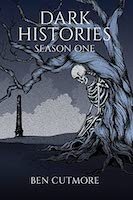
Review: Dark Histories: Season One

58865157._SY475_.jpg

5 stars. Recommended for fans of:

  • The podcast, obviously

  • Unsolved mysteries in general, and also Unsolved Mysteries the TV show (I prefer Robert Stack over Netflix)

  • Wikipedia

  • Folklore

  • True crime

  • All things creepy and/or disturbing

This was the perfect palette cleanser in-between chapters of other books and episodes of things; perfect to pick up for a brief 10-minute break during the day. Probably not for those interested in reading dry, thorough academia... this is lighter and less detail-ridden, and has more of an around-the-campfire tone. As a fan of the podcast, I could practically hear Ben's voice in my head! His tone is unmistakable.

Season One covers classics such as Jack the Ripper and the Somerton Man, lesser-known mysteries like the Plimco Poisoning, and even a creepy contemporary case about the strange death of Joshua Maddux. My personal favorite is the episode about Dorothy Eady/Omm Sety, but the one about Terri Hoffman is absolutely wild.

I really enjoyed revisiting these mysteries in book form. Well done to Ben for his accomplishments in both formats!

Dark Histories: Season One on: Amazon | Bookshop.org | Goodreads

Review: The Cold Vanish

48717769.jpeg

4 stars. The Cold Vanish is about the unexplained disappearance of Jacob Gray, and the astounding number of similar disappearances in National Parks across the US. It is not strictly historical or descriptive non-fiction (though it appears to be incredibly well-researched); the author spent some time with Jacob's father and offers a lot of personal insight into the tragedy and its impact. I should mention: I've seen some back-and-forth about whether or not Billman may have exploited, manipulated or mischaracterized Jacob and his family - I can't offer an informed comment on this, but I truly hope this wasn't the case.

I think it's pretty clear that this is for fans of true crime, Missing: 411 and especially Unsolved Mysteries. I would argue that this is probably ONLY for fans of those things. It's appeal to me was and still is the premise and that alone. If you're the type of person who can read chapter after chapter containing slightly varied versions of what is essentially the same super dark story, you won't hate this. You'll be gripped by the mysteries, the bizarre details, the lure of answers and the ultimate lack of them. So in that sense, The Cold Vanish succeeds. In execution, maybe less so.

Yeah, the writing is a bit weird here. There are impressive moments of description and observation, but in between those are instances of amateur repetition and over-the-top levels of detail. As I mentioned above, it's very well-researched. It perhaps could've used some sharper edges, or some smarter editing. It's not bad, by any means. It gets the job done. I also could have gone without the long chapter about Duff and his bloodhounds. It smelled like a vehicle for the author to try out a sort of darkly funny attempt at gonzo journalism, or something. Sure, Duff sounds like a character and his hounds seem very talented. I was just bored.

Conclusions are few and far between. You'll know this going in. The questions, and the possibilities, are endless. A few things that really got me:

- If you go missing in a poor county, you are far less likely to be found. I suppose I knew this, being somewhat familiar with local governments and SAR budgets, but to really see and feel that was sickening. This country, man. This fucking country.

- To have hope is far worse than having closure. I also sort of knew that already, but the stories told here paint it as painfully true.

- In the wilderness, it's actually not that difficult to disappear. That's what's so fascinating about it - what's difficult is to pinpoint the how/why/where.

Jacob's story - and the other stories featured here - are haunting and deeply unfortunate. But the book is full of heartening stories, too... stories of survival and determination and resilience. I've always personally been drawn to the dark stuff, especially mysteries like these, but I always try to appreciate and respect the impact on those involved. In my opinion, Billman threads that needle as well as possible.

The Cold Vanish on: Amazon | Bookshop.org | Goodreads

Review: Midnight in the Garden of Good and Evil

386187.jpg

3 stars. I went into this totally blind, except knowing that it's considered a classic and gives off potent Southern Gothic vibes. I vaguely remembered it as a nonfiction book, BUT THEN I started reading it, and 25% of the way in was like ... there's no way this is nonfiction. BUT THEN I looked it up to confirm, and lo and behold, apparently this IS nonfiction. BUT THEN I read on Wikipedia (all hail) that the author did admit - as he eventually does in his afterword - to fabricating some characters and events to make the book read better.

And wow, it worked. This book reads like a smooth, buttery biscuit. Crunchy, sweet, and well-baked with the harsh aftertaste of racism. Gotta love the American South. Midnight is one hundred percent too good to be true, but I wouldn't be surprised if MOST of it did happen - just not in the neat and tidy way the story is written. I've met people who embody certain stereotypes from all over the country, and not one of them fit THAT perfectly into the mold. I'm quite sure the author met these folks and then conveniently turned them into storybook characters, which is neither here nor there.

Anyway, Midnight is a *cough cough* nonfiction novel about that time an established antiques dealer shot and killed his young male lover in his famous historic mansion. The core story itself, which details the crime, the trial and the town's reaction, is surrounded and sandwiched by captivating vignettes about Savannah, Georgia. Every little detail is fascinating from a location perspective and a people perspective, providing an insider view of Savannah's secrets and scandals.

Just a quick note: the events captured in this book happened recently. At times I caught myself assuming it all went down a century or more ago, thanks to some seriously ignorant, racist, sexist, homophobic, intolerant attitudes. But no, my parents were super alive when this happened - in fact, Jim Williams died a year to the day before I was born. While this is astounding but not surprising, it actually makes me hopeful that in like what - thirty, forty years? We'll have progressed even further, even in the South.

Midnight is one part anthropological study, one part courtroom drama, one part portrait of a stubborn city in America. I wouldn't exactly call it true crime, though that may be because I'm used to the graphic true crime content explosion of the last five years. Anyway, it has all the things I love. And the ending - the final few paragraphs - really got me. I'm glad this story was told, and I hope others like it will be told - in words rather than crime scene photos, in whispers rather than shouts.

Midnight in the Garden of Good and Evil on: Amazon | Bookshop.org | Goodreads